Data, IA, and Law Firm Management Software: How Littler is Positioning Itself for the Future
"Like a Swiss Army Knife": Why Littler Relies on timeSensor


Law firm management software “like a Swiss Army Knife”
Interview with Sebastian Juli · Partner Lawyer, Littler Germany · Law Firm Blog
Littler is the world’s largest labor law firm. In Germany, over 80 legal professionals use timeSensor LEGAL 365 – since 2013, starting as Vangard, now as Littler. An interview about Mac compatibility, data warehouse, IA, and why the software functions like a Swiss Army knife.
Please briefly introduce the Littler law firm.
Littler is the world’s largest labor law firm. In Germany, we have more than 80 legal professionals, all practicing labor law. Worldwide, we have more than 1900 legal professionals in 30 countries and over 100 offices. In Europe, there are 400 legal professionals in 14 countries.
We all work in labor law, but not all of us use timeSensor. timeSensor is used exclusively in Germany. The reason lies in our history. In 2013, we founded our law firm under the name Vangard. From 2015, we deepened our collaboration with the US law firm Littler as the first European firm. Since 2024, we operate under the name Littler, thus becoming the world’s largest labor law firm.
Littler Germany PartG mbB is an independent partnership and part of a Swiss association, because in a Swiss association – unlike German association law – a company can also become a member of an association.
When and how did you come to timeSensor?
The reason at the time was that we were looking for a multi-location law firm management software. Because we all worked on Mac computers, my colleague Jan-Ove Becker researched and found that timeSensor was a software that runs on Mac. In Düsseldorf, we still had a very old, self-built law firm management software, and in Hamburg, our colleagues worked with ra-micro. However, we were not happy with these solutions. That’s why we decided on timeSensor.
And yes, at the beginning, the supra-regional collaboration with timeSensor didn’t work so well because internet connections in Germany were not as good as in Switzerland. For example, if you accessed the timeSensor server installed in Düsseldorf from Munich, everything always took a very long time. This was not due to timeSensor, but to the infrastructure. We then switched to a remote server, a kind of cloud – since then, we can access timeSensor quickly from anywhere in the world.
What challenges did you face on the way to the new law firm management software?
There were indeed many challenges, because there is no ideal software, and you always have to make compromises somewhere. So the question is always: Where do we make which compromises? Another challenge is that there are many providers of law firm management software. There are providers who are incredibly strong in one area, but for example, do not offer law firm management and document management combined.
So we had to decide in good time what was important to us and make the right compromises. Ultimately, we ended up with the software where the overall feeling was best – and that was clearly timeSensor LEGAL 365.
What were the decisive arguments for the switch?
Decisive factors were, on the one hand, Mac compatibility, but also making our law firm management software suitable for nationwide use. Of course, also the direct contact with timeSensor’s CEO, Mr. Solenthaler, and the programmers. This allowed us to develop individually. We always had a direct line if something didn’t work in between.
What was particularly exciting about timeSensor was the possibility for our back office to work very closely with timeSensor. Together with timeSensor, we further developed the law firm management software – for all digital work processes and, for example, for the automated creation of RVG invoices.
Initially, the software was very tailored to the Swiss market, which was evident, for example, in wording like “manipulate invoice.” However, this is no longer the case today. We also identified further needs in data collection and data analysis. Through timeSensor, we then came into contact with Mr. Eberhardt and his team, with whom we developed a data warehouse.
Mr. Eberhardt also helped us use the LAWLIFT tool in mass proceedings. This allows us to import all relevant data from the data warehouse into LAWLIFT and create customized documents – perfectly formatted under the Client’s letterhead and, if desired, bilingual.
Where do you use timeSensor and Business Intelligence?
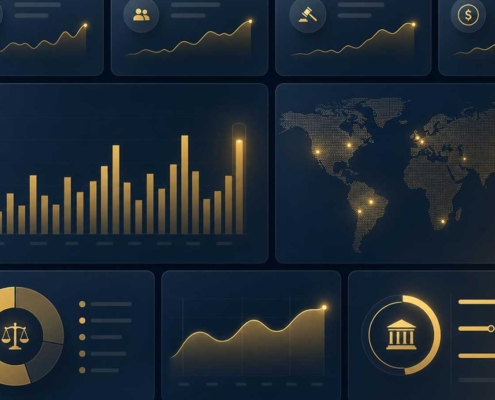
At the beginning, of course, was the desire to find out for ourselves how productive we are. Above all, we wanted to see how well utilized each individual lawyer is and what contribution each individual lawyer makes to a specific invoice. For example, if several lawyers work on a Matter, it is crucial for us for each individual invoice to know who contributed what. Given our size, this was only comfortably possible by establishing a data warehouse, and it was also one of our first steps in Business Intelligence.
Meanwhile, we evaluate significantly more data. Based on the data, we can see, for example, what kind of business we have and how it is developing. Do we still have many Clients with unfair dismissal cases? How many actually buy employment contracts or other documents from us, or are we no longer doing that at all? This is relevant because our legal profession will also change significantly due to IA. It is therefore very important to be able to quickly identify which services are still in demand from us and to what extent in times of IA.
Furthermore, we believe that the interaction between people – i.e., the lawyer and the Client – will become increasingly important. Clients rightly expect data-driven, strategic advice. We primarily work in the B2B sector, i.e., with companies. IA will also simplify the work of in-house lawyers in companies, but our specialized advice will remain relevant. Data-driven, we can offer even better consulting services.
First and foremost, it is important for us to have our data under control. The legal consulting industry will come under increasing pressure from IA. As a result, fixed-price offers will become increasingly important, because it will become more and more difficult to justify hourly rates. So we have to ask ourselves which consulting services we no longer offer and which new products the market demands instead. Business Intelligence helps us with these decisions.
An example of our data-driven consulting is our Legal Tech product “Littler View”. We know what data we need to calculate a social plan. We can calculate the specific economic disadvantages each individual employee actually incurs if their user is eliminated – and what severance payments we must offer to compensate for these disadvantages. These are significantly lower amounts than those often demanded by works councils and trade unions.
How did your employees react to the introduction of BI?
Most partners and lawyers were not very interested in the law firm management software – the main thing was that it worked. However, the back office, in particular, appreciated the introduction of timeSensor. But even there, problems immediately come to the forefront, because for a law firm, it is extremely important that the law firm management software works. Almost all processes depend on it, but above all, the invoicing runs and open item lists.
Some colleagues wanted more data and were disappointed that we had to invest more money to get these functions in timeSensor. They thought that this data should already be available directly in the law firm management software. And some imagined it to be simpler and faster, because ultimately the whole thing took three years.
The support from timeSensor was always good. timeSensor always made sure that everything ran smoothly, and of course, there were training sessions at the beginning. Our team has been with us for so long now that everyone is completely familiar with the software. We have now reached a point where everything works, and we benefit enormously from timeSensor and Business Intelligence. I believe that the change has made us significantly more future-proof.
Do you also use your IT solutions for new business models?
All the data we have collected can be used in many areas. Especially when using IA in legal work. Because for partially automated document creation, good datasets are crucial. We can now create entire employment contracts by filling out a simple questionnaire.
However, whether automated document creation actually represents a future business area remains to be seen. Because our Clients can also create documents more easily themselves with IA. However, we ourselves can do this a bit better because we can incorporate more experience from other companies and are highly specialized.
For the future, however, we are definitely well-positioned by using Business Intelligence and having the data we need available. This way, we always know which services we can productively offer and which are no longer in demand.
What recommendations would you give to other law firms?
Every law firm management software has advantages and disadvantages, and weaknesses and strengths. What definitely speaks for timeSensor is the direct line to the management and the programmers. And also that the software is quite flexible and the support is individual. This is different from just being able to call an anonymous hotline, as is the case with Microsoft or SAP, for example. It’s different with a software provider like timeSensor.
How do you rate the collaboration with timeSensor?
timeSensor is like a Swiss Army knife. While there are more specialized providers for most areas, timeSensor is exactly right for our core tasks because the software reflects our actual workflows and offers the flexibility to adapt to us. We don’t have to organize ourselves around the software or restrict ourselves, as would be the case with large providers like SAP, for example.
I particularly appreciate the good cooperation – that you always have a contact person you can reach and with whom you have experienced and gone through many changes together.
timeSensor is like a Swiss Army knife. We don’t have to organize ourselves around the software or restrict ourselves, as would be the case with large providers like SAP, for example.
Since 2013, the Littler law firm has been using our software, now in its second generation, timeSensor LEGAL 365. We are very pleased that they shared their experiences with us. The interview was conducted by a lawyer working in Germany and an experienced journalist. Our special thanks go to Sebastian Juli and the entire Littler team for their constructive cooperation and valuable insights into the use of timeSensor LEGAL 365 and Business Intelligence.